
Notes from the foundry
Far Haul: From a Ship Builder to a World
The first Far Haul prototype quickly expanded beyond modular ships into the data and simulation needed for a freight-driven universe.
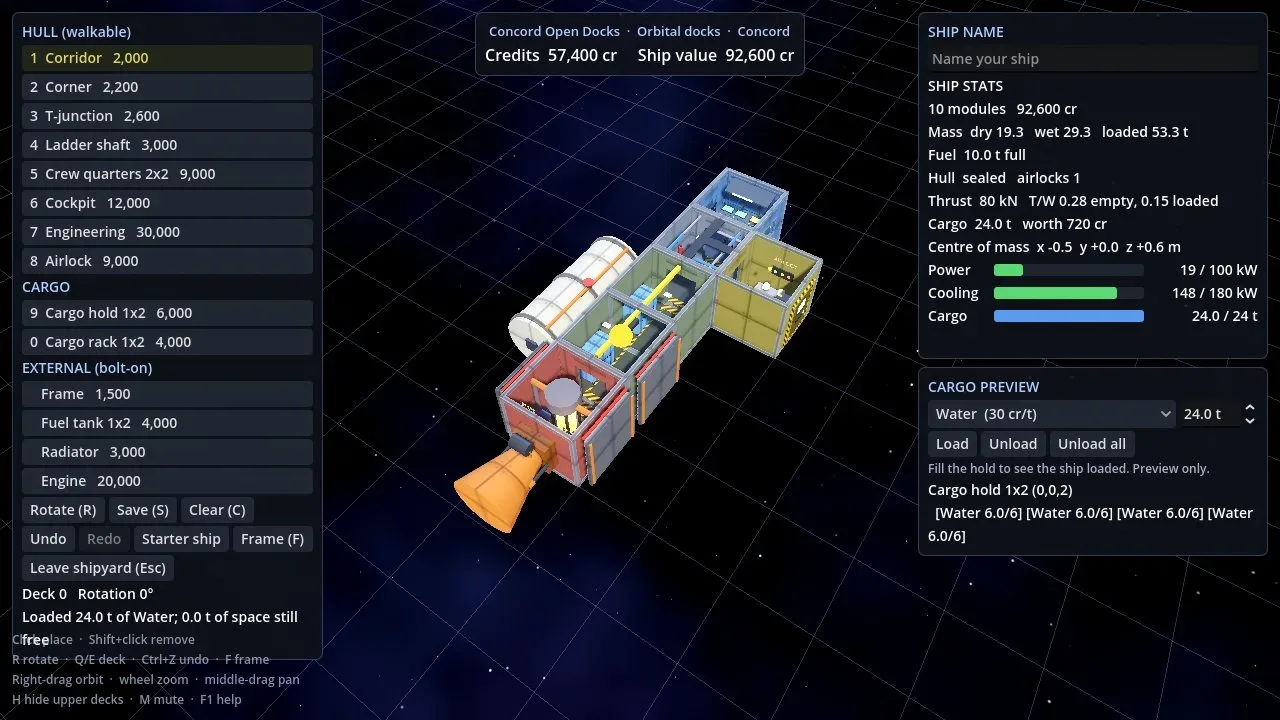
Far Haul began with a practical question: what does a freight ship look like when the player actually has to live with the decisions that built it?
The first working prototype focused on the ship itself. Instead of treating a spacecraft as a menu of abstract upgrades, the goal was a modular, utilitarian machine whose layout and components could eventually become a physical place the player walks through, maintains, repairs, and modifies.
That immediately exposed the larger problem. A freight ship only matters if there is a world that gives it work.
The project therefore expanded quickly into structured world data: ship components and compatibility, used equipment and condition, physical cargo packaging and handling requirements, ordinary commodities and institutional demand, frontier survey work, government and culture, orbital mechanics, physical astronomy, and economic accounting. Much of that work is deliberately mundane. Far Haul needs food, machinery, replacement parts, industrial inputs, household goods, fuel, and all the other things inhabited places consume—not just a handful of science-fiction trade items.
The same principle applies to exploration. The frontier is intended to be large enough that discovery can become ordinary work rather than a short scripted sequence. Survey information can have ownership and value. Systems can move from known routes to sparse settlements and then into places where the player is helping establish what is known at all.
A lot of this is still foundation rather than finished gameplay. That distinction is important. Data models and design documents are not the same thing as a playable universe.
But they give the prototype somewhere to grow. The ship builder is no longer an isolated toy. It is becoming the physical center of a freight and exploration game.